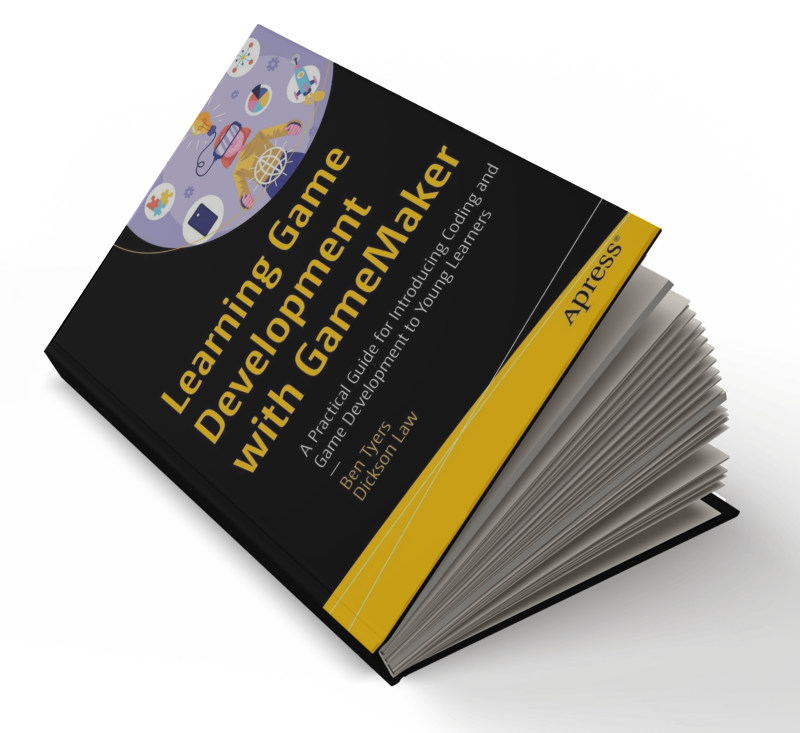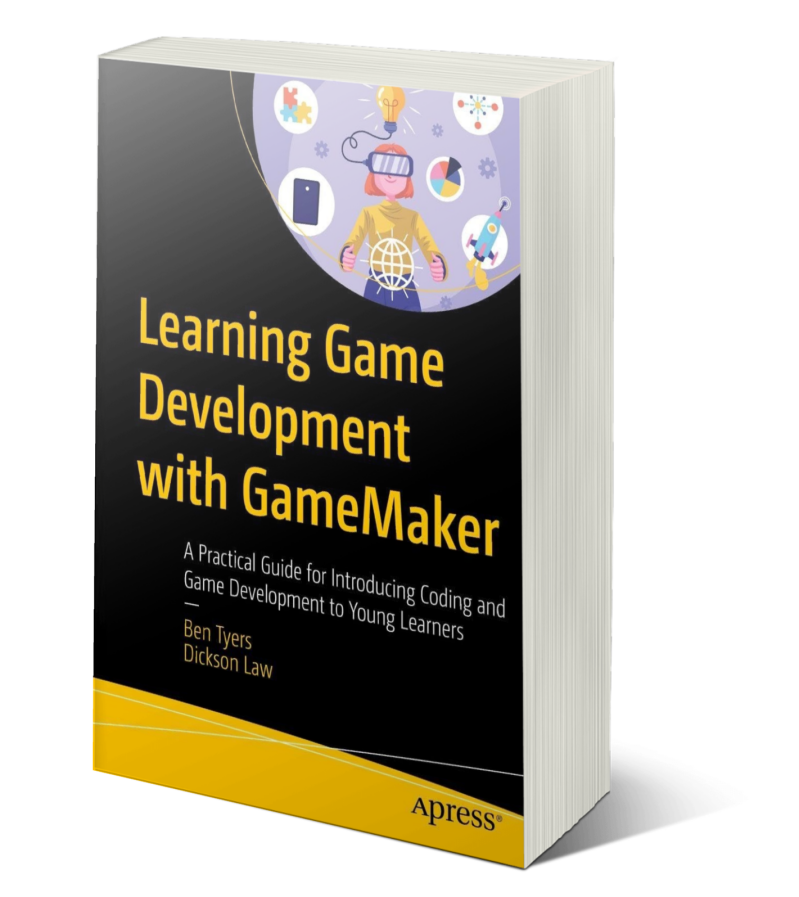
Learning Game Development with GameMaker:
A Practical Guide for Introducing Coding and Game Development to Young Learners
Turn your game ideas into reality! This book is a hands-on guide to using GameMaker and its scripting language (GML). It is tailored for classroom use, suitable for both educators and students.
We will start with essentials such as installing GameMaker, navigating the IDE, and organizing your projects for success. You will learn of sprites, objects, events, variables, collisions, audio, and GUI design. We will also cover implementing AI, alarms, loops, arrays, and state control to create dynamic gameplay. The book also covers how to publish your game. Each chapter ends with a quiz to reinforce what has been covered.
With clear explanations, hands-on examples, and over 50 mini-game ideas, this book transforms beginners into confident developers. By the end, you’ll have the skills to design, prototype, and publish polished games using GameMaker.
You Will
- Create, name, and organize assets such as sprites, sounds, fonts, and rooms
- Gain skills in input handling, state control, movement, and collision detection
- Explore effect layers, camera control, and resource optimization
Who This Book Is For
This book is suitable for teachers and students learning GML
AVAILABLE NOW ON AMAZON & OTHER ONLINE STORES
Search For The ISBN: 979-8868828812

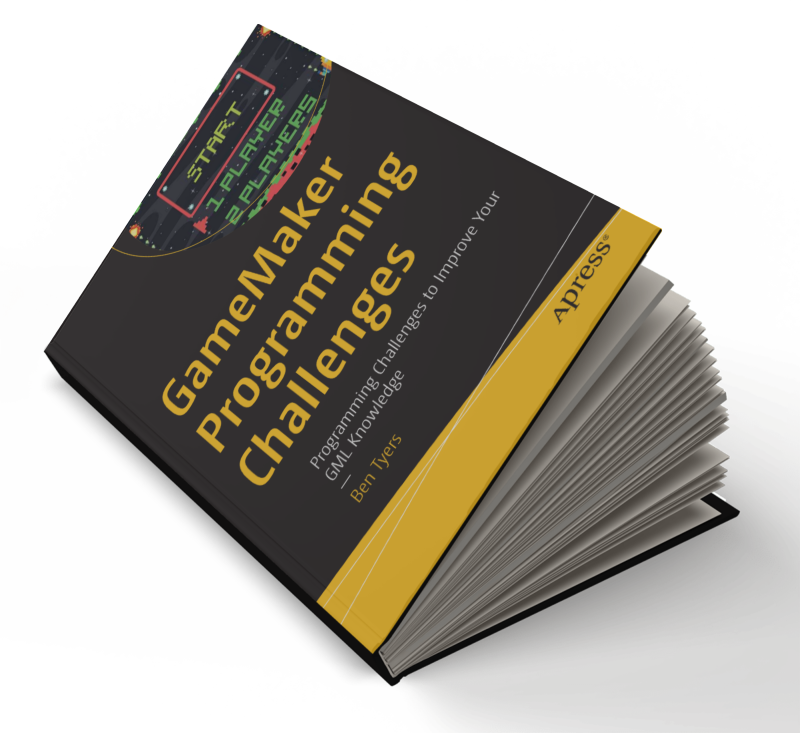
GameMaker Programming Challenges:
Programming Challenges to Improve Your GML
Upgrade your GameMaker programming skills with 500 programming challenges. The book is a collection of programming challenges, covering a range from simple to advanced concepts.
GameMaker is a hugely popular tool and is regarded one of the best approaches for 2D games. GameMaker allows both visual and code-based approach for game development and has been used for multiple hit titles. Each chapter covers a certain programming element, such as Sprite Fonts, Projectiles, Mechanics, etc.
The book is designed in a manner where each challenge provides an outline of the problems, useful functions, hints on tackling the challenge, and an example solution. On completion, you will take away new knowledge of GameMaker functions, an ability to think logically when developing code, and a better understanding of game design and planning.
What You Will Learn
- Study the new GML, from basic functions to more evolved concepts.
- Gain ability to view example solutions when necessary.
- Increase your understanding of game design concepts.
Who Is This Book For
Beginners to intermediate level readers with basic understanding of GameMaker’s IDE, including creating object, sprite, and sound assets will benefit from this book.
AVAILABLE NOW ON AMAZON & OTHER ONLINE STORES
Search For The ISBN: 979-8868821288
Programming Challenges
GameMaker Programming Challenges: Programming Challenges to Improve Your GML Knowledge is a practical collection designed to help GameMaker users develop their programming and game design abilities through hands-on problem solving. Rather than teaching GameMaker through conventional chapters and lengthy explanations, the book presents 500 individual programming challenges, encouraging readers to experiment, research functions, develop solutions, and improve their understanding of GameMaker Language (GML).
Each challenge follows a consistent format. A short project outline explains what the reader is expected to create, followed by a selection of useful GameMaker functions and built-in variables. A brief hint then suggests an approach without providing a complete step-by-step solution. Challenges are rated from 1 to 5 in difficulty, ranging from simple exercises requiring only a few functions to advanced problems requiring considerably more logic and programming knowledge. Readers can also mark challenges as completed, making the book suitable for progressive independent study.
The projects cover an exceptionally broad range of game-development techniques. Early challenges introduce relatively focused tasks such as keeping an instance inside a room, detecting line of sight, saving level-completion information, displaying health, manipulating arrays, creating draggable objects, producing mini maps, and reading random words from text files. These exercises introduce commonly used concepts such as collision detection, loops, arrays, drawing functions, mouse and keyboard input, files, alarms, instance IDs and movement.
As the challenges progress, readers encounter increasingly varied game mechanics. Examples include weapons, projectiles, power-ups, health systems, checkpoints, menus, scrolling interfaces, paths, particle effects, camera controls, animations, audio systems, dialogue, character selection, procedural placement and enemy behaviours. The book frequently combines several GameMaker features within a single problem. For example, weapon-related exercises involve projectile creation, positioning, rotation and targeting, while visual-effect challenges explore smoke, muzzle flashes, shadows, fireworks, fades and other graphical techniques.
Later projects introduce more specialised systems such as positional audio, branching dialogue, avatar creation, text-file-generated levels, AI-controlled shooting, object avoidance, programmable characters, stealth zones, dynamic shadows, proximity mines, reflecting projectiles, spreading fire and increasingly complex movement behaviours. The final challenges continue this emphasis on gameplay systems and enemy AI, including teleporting enemies, patrolling guards, area explosions, variable damage, zombie enemies, upgrades, random paths and reinforcement callers.
Overall, the book is best viewed as a large practice workbook for GML programming rather than a traditional instructional manual. It encourages readers to learn by building, testing and solving problems themselves. Because the challenges range from straightforward programming exercises to sophisticated gameplay systems, they can be used for structured learning, classroom activities, revision, coding practice or inspiration for features in larger GameMaker projects. The variety of the 500 challenges also demonstrates how individual GML functions and programming concepts can be combined to create practical, reusable game mechanics.